Chapter 2
Chapter 2
The Arc of Numbers 1–5 — Where This Chapter Sits
The wilderness book's opening five chapters address one unifying question: Yahuah dwells in the midst of his people — how is the camp arranged, ordered, and kept holy? Numbers 1 counts the tribes (who is present). Numbers 2 arranges them geometrically (where each stands). Numbers 3–4 organizes the Levites for the tabernacle's inner service (who serves the dwelling). Numbers 5 addresses defilement (what compromises the dwelling and how it is handled). Each chapter answers a question the previous chapter raised. Numbers 2 gives the spatial answer: with the mishkan at the center, the tribes camp on four sides in fixed formation, three tribes per side, twelve tribes around the presence.
Keywords
encamp/חנה [h2583] • standard/banner/דגל [h1714] • signs/emblems/אתת [h226] • house of fathers/בית אבות [h1] • opposite/at a distance/מנגד [h5048] • around/סביב [h5439] • tent of meeting/אהל מועד [h168] • eastward/sunrise/קדמה מזרחה [h6924] • camp/מחנה [h4264] • armies/צבאות [h6635] • prince/נשיא [h5387] • tribe/מטה [h4294] • southward/תימנה [h8486] • westward/seaward/ימה [h3220] • northward/צפנה [h6828] • set out/journey/נסע [h5265] • midst/בתוך [h8432] • at his hand/next to him/על־ידו [h3027] • commanded/צוה [h6680]
Aleph/Tav × 2 occurrences (both at v.33, v.34 — the closing compliance-frame bound to Moshe) • The lowest AT count of any chapter so far — because the entire chapter is the implementation of the command already given, and the previous chapters have already bound the command by the symbol. The tribal geometry itself is presented unadorned: the pattern is the message. Four sides, three tribes per side, mishkan at center, Levites as inner ring — the ordered cosmos of the covenant camp
THE CAMP AROUND THE MISHKAN — NUMBERS 2
N S W E MISHKAN Camp of Dan — 157,600 — marches last (rear guard) Naftali 53,400 DAN 62,700 Asher 41,500 Camp of Reuben — 151,450 — marches second Gad 45,650 REUBEN 46,500 Shim'on 59,300 Camp of Yehudah — 186,400 — marches first Zebulun 57,400 YEHUDAH 74,600 Yissakhar 54,400 Camp of Ephrayim — 108,100 — marches third Binyamin 35,400 EPHRAYIM 40,500 Menasheh 32,200 Merari (north) Kohath (south) Gershon (west) Aharon & sons (east) Total: 603,550
Twelve tribes arrayed as a closed square perimeter around the mishkan — three tribes per side, each side a “camp” under one master-standard, lead tribe at the outer (cardinal-direction) edge. The Levite ring (dashed square) forms an inner perimeter around the mishkan itself. Corners of adjacent camps touch, closing the formation on all sides. Same geometry as the eschatological Yerushalayim in Ezek 48:30–35 and Rev 21:12–13.
[Numbers 2:1–34 — Retranslation from the Hebrew]
The Command — Each Man by His Standard (v.1–2)
1 And Yahuah spoke [h1696] to Moshe (Moses) and to Aharon (Aaron), saying:
📖 This is the first divine speech-formula in the wilderness book addressed to both Moshe AND Aharon together. Num 1:1 addressed Moshe alone. The arrangement of the camp is entrusted to both the prophet and the priest — the ordering of space around the mishkan involves the man who receives the word and the man who mediates the presence. The two offices meet at the geometry of the camp.
2 “Each man by his standard [h1714], with the signs [h226] for the house of their fathers, shall the sons of Yisra'al encamp [h2583]; at a distance [h5048] around [h5439] the tent of meeting shall they encamp.”
📖 איש על־דגלו — “each man on/by his standard.” The word דגל (degel) is the tribal banner — the emblem of the tribe under which each man takes his position. Compare Song 2:4 (“his banner over me is love”) and Song 6:4, 6:10 (“terrible as an army with banners”). The banner is not decoration; it is covenantal identity made visible. Every Israelite knows which flag is his.
📖 באתת לבית אבתם — “with the signs (emblems) for the house of their fathers.” The word אתת (otot) is the plural of אות (ot, sign) — the same word used of the rainbow (Gen 9:12), circumcision (Gen 17:11), and the Sabbath (Exod 31:13). Each tribe carries an ot — a covenantal sign identifying its house of fathers. Ancient Jewish tradition (Bamidbar Rabbah 2:7) associates each tribe's emblem with the deathbed blessings of Ya'akob in Gen 49: Yehudah's lion, Reuben's water/man, Ephrayim's ox (or wild ox), Dan's eagle or serpent.
📖 מנגד סביב לאהל־מועד — “at a distance, around, for the tent of meeting.” Two spatial qualifiers: מנגד (min-neged, “at a distance / over against”) and סביב (saviv, “around”). The tribes do not press against the mishkan; they stand back at reverent distance AND they surround it on all sides. The word מנגד is the same word used in Exod 20:18 when the people “stood at a distance” from Sinai. Reverent proximity, not casual access. The circle is drawn wide enough that the Levite ring can fit between the twelve tribes and the mishkan (Num 3:23, 29, 35, 38).
📖 The lamed on לבית אבתם (for the house of their fathers) and לאהל־מועד (for the tent of meeting) — the standards belong FOR the fathers' house; the encampment is FOR the tent of meeting. Everything oriented toward.
📖 סביב as continuous surround. The word סביב (saviv, “around”) in this verse is the same word used in Ezek 48:35 to close the description of the eschatological Yerushalayim: סביב שמנה עשר אלף (“around, eighteen thousand” — giving the total perimeter length of the city's four equal square sides, three tribal gates each). The word is used elsewhere for continuous enclosure (Josh 6:3–4, the seven-day march around Yericho; Exod 26:3 for the tabernacle's joined curtains). Whatever the exact metric geometry of the wilderness camp, the Hebrew grammar of סביב presses toward a closed perimeter surrounding the mishkan on all sides — the same enclosure-word that names the eschatological city's square perimeter. The wilderness pattern is a closed formation, prefiguring the closed formation of the eternal city.
The Eastern Camp — Yehudah Leads (v.3–9)
3 And those encamping eastward [h6924] toward the sunrise [h4217]: the standard of the camp of Yehudah (Judah), for their armies. And the prince for the sons of Yehudah — Nachshon (Nahshon) son of Amminadab.
📖 קדמה מזרחה — a double directional. קדם (qedem) means both “east” and “forward / former / ancient” — the direction and the primordial-past are one word. מזרח (mizrach) means “place of rising / sunrise.” The two words together intensify the direction: the leading camp faces where the sun rises AND where the beginning is. East is where Eden was planted (Gen 2:8, מקדם, “in the east”). East is where the tabernacle's entrance faces (Exod 27:13). East is where Yahuah's glory returns in Ezek 43:2. Yehudah faces the ancient direction.
📖 Yehudah leads. The messianic tribe takes position first — the leading edge of the covenant people. Nachshon son of Amminadab (v.3) is in the messianic genealogy (Matt 1:4, Luke 3:32) — David's ancestor, Yahusha's ancestor. The one who marches first at the head of the covenant nation is himself in the line of the coming King. Gen 49:8–10: “Yehudah, your brothers shall praise you; your hand shall be on the neck of your enemies… the scepter shall not depart from Yehudah, nor a lawgiver from between his feet, until Shiloh comes.” The tribe with the scepter promise leads the procession.
📖 The lamed on לצבאתם (for their armies) and לבני יהודה (for the sons of Yehudah). The standard is FOR the armies; the prince is FOR the sons. Each element serves its category.
4 And his army and their numbered ones: seventy-four thousand six hundred.
5 And those encamping next to him [h5921]: the tribe of Yissakhar (Issachar); and the prince for the sons of Yissakhar — Netan'al (Nethanel) son of Tsu'ar (Zuar).
6 And his army and its numbered ones: fifty-four thousand four hundred.
7 The tribe of Zebulun (Zebulun); and the prince for the sons of Zebulun — Eliab son of Chelon (Helon).
8 And his army and its numbered ones: fifty-seven thousand four hundred.
📖 The three eastern tribes are all sons of Leah (Yehudah, Yissakhar, Zebulun — her fourth, fifth, and sixth sons, per Gen 29:35, 30:18, 30:20). The eastern camp is the Leah-camp — the tribe of the woman Ya'akob was tricked into marrying, whose sons include the messianic line. The unloved wife's sons take the leading position. Compare Deut 21:15–17 (the rights of the firstborn of the unloved wife) and Rom 9 (Sha'ul's meditation on how Yahuah chooses through what looks like the lesser).
9 All the numbered ones of the camp of Yehudah: one hundred thousand and eighty thousand and six thousand and four hundred, for their armies. First [h7223] shall they journey [h5265].
📖 Total for the eastern camp: 186,400. The largest of the four camps. And ראשנה יסעו — “first shall they journey.” When the camp breaks and moves, Yehudah's standard leads the whole procession. The lion tribe at the front. When the assembly moves forward through the wilderness, the messianic banner is the point of the arrow.
The Southern Camp — Reuben Leads (v.10–16)
10 The standard of the camp of Reuben (Reuben) southward [h8486], for their armies. And the prince for the sons of Reuben — Alitsur (Elizur) son of Shede'ur (Shedeur).
📖 תימנה (teimanah) — “southward.” The word תימן (teiman) is south (where Yemen gets its name, from being at the southern extremity of the Arabian peninsula). South is the direction of the wilderness (the Negev extends south of the Judean hill country).
📖 Reuben leads the southern camp. Reuben is the firstborn of Ya'akob (Gen 29:32) — but he forfeited his birthright by defiling his father's bed (Gen 35:22, 49:4). He does not lead the whole camp (Yehudah does that); but he leads the southern quadrant. The firstborn retains a leading position, but the diminished one — second position in the marching order, not first. The birthright transferred to Yoseph's sons (1 Chr 5:1–2) is visible in the geometry: Reuben leads south, but the double-portion Yoseph tribes (Ephrayim and Menasheh) lead west.
11 And his army and its numbered ones: forty-six thousand five hundred.
12 And those encamping next to him: the tribe of Shim'on (Simeon); and the prince for the sons of Shim'on — Shelumi'al (Shelumiel) son of Tsuri-Shaddai (Zurishaddai).
13 And his army and their numbered ones: fifty-nine thousand three hundred.
14 And the tribe of Gad; and the prince for the sons of Gad — Alyasaf (Eliasaph) son of Re'u'al (Reuel).
15 And his army and their numbered ones: forty-five thousand six hundred and fifty.
📖 The southern camp: Reuben, Shim'on, Gad. Reuben and Shim'on are Leah's first and second sons (Gen 29:32–33); Gad is son of Zilpah, Leah's handmaid (Gen 30:10–11). The southern camp is composed of Reuben's brotherhood plus one handmaid-son. Shim'on is the demoted second son (Gen 49:5–7, “I will scatter them in Ya'akob and disperse them in Yisra'al” — Shim'on gets no independent territory in Josh 19:1–9, absorbed into Yehudah). His demotion is visible in southern placement rather than eastern.
16 All the numbered ones of the camp of Reuben: one hundred thousand and one and fifty thousand and four hundred and fifty, for their armies. And second [h8145] shall they journey.
📖 Total for the southern camp: 151,450. The second-largest. And ושנים יסעו — “and second shall they journey.” The firstborn-forfeited tribe marches in second position — the honor of the birthright preserved in the marching order even after the birthright itself passed to another. Reuben still walks second, right behind Yehudah, in every march.
The Center — The Mishkan Moves With Its Guardians (v.17)
17 Then the tent of meeting shall journey, the camp of the Levites in the midst [h8432] of the camps; as they encamp, so shall they journey, each one at his hand [h3027], for their standards.
📖 The pivot verse of the chapter. Structurally central (v.17 of 34 verses, essentially the midpoint). Content: the mishkan and the Levites move BETWEEN the second and third camps in marching order. The center of the camp remains the center EVEN IN MOTION. Wherever the covenant people go, the presence is always in the middle. Static or moving, the geometry does not change.
📖 בתוך המחנת — “in the midst of the camps.” The plural “camps” because each of the four sides is called a camp. The Levites and mishkan are in the midst of the four camps, forming their own inner camp. The physical arrangement teaches the theology: covenant life is life-with-the-presence-at-center. Compare Deut 4:7 (“what great nation has Alahym so near to it as Yahuah our Alahym is to us, for whatever reason we may call upon him?”) and Ps 46:5 (“Alahym is in the midst of her; she shall not be moved”).
📖 כאשר יחנו כן יסעו — “as they encamp, so shall they journey.” Camp-formation and march-formation are one. The order is stable across states. When you see the camp at rest, you see the marching order. When you see the marching order, you see the resting camp. This is a theological point about the ordered life: the pattern is not situational, it is constitutive.
📖 The Levite positions around the mishkan itself are detailed in Num 3: Gershon to the west, Kohath to the south, Merari to the north, and Moshe/Aharon and his sons to the east (guarding the tabernacle entrance). Each tribal camp is thus “matched” by a Levite clan on its interior side. The inner ring and outer ring correspond.
📖 The vertical axis at the center. The mishkan stands upright in the middle of the closed square perimeter — a vertical structure at the horizontal center of the camp. This vertical-axis-at-center pattern is one of the deepest architectural motifs in scripture. The tree of life stands at the center of the garden of Eden (Gen 2:9). The mishkan stands at the center of the wilderness camp (Num 2:17). The temple stands at the center of Yerushalayim (1 Kings 6). The stauros (σταυρός, a vertical stake — from the root στα-, ἵστημι, “to stand”; classical Greek usage in Homer, Herodotus, Thucydides consistently denotes an upright stake) stands vertically at Golgotha (Matt 27:35). And the throne of Alahym-and-the-Lamb stands at the center of the New Yerushalayim (Rev 22:1–3), with the tree of life restored (Rev 22:2). The same vertical-axis-at-center pattern from Eden to eternity. In every case, a vertical presence stands at the middle of a bounded space, with the people of the covenant arrayed around it. Num 2 gives the wilderness instance of this cosmic pattern.
The Western Camp — Ephrayim Leads (v.18–24)
18 The standard of the camp of Ephrayim (Ephraim), for their armies, westward [h3220]. And the prince for the sons of Ephrayim — Alishama (Elishama) son of Ammihud.
📖 ימה (yamah) — literally “seaward.” Hebrew geography orients from the sunrise; the sea (Mediterranean) is to the west, so “seaward” = west. The direction-word is a testimony to the land's orientation.
📖 Ephrayim leads the western camp. Ya'akob's crossed-hands blessing at Gen 48:17–20 is here operationalized: Ephrayim (younger son of Yoseph) placed before Menasheh (elder). Yoseph's absent tribe is represented double — both Ephrayim and Menasheh camp west. The one who was sold into slavery by his brothers now has his two sons together leading the western quadrant.
19 And his army and their numbered ones: forty thousand five hundred.
20 And next to him: the tribe of Menasheh (Manasseh); and the prince for the sons of Menasheh — Gamli'al (Gamaliel) son of Pedah-Tsur (Pedahzur).
21 And his army and their numbered ones: thirty-two thousand two hundred.
22 And the tribe of Binyamin (Benjamin); and the prince for the sons of Binyamin — Abidan son of Gid'oni (Gideoni).
23 And his army and their numbered ones: thirty-five thousand four hundred.
📖 The western camp: Ephrayim, Menasheh, Binyamin. All three are sons/grandsons of Rachel — the beloved wife. The western camp is the Rachel-camp. Yoseph's two sons (Ephrayim and Menasheh, per Gen 48) plus Rachel's own younger son Binyamin. The wife Ya'akob loved has her sons together on the seaward side. The eastern camp (Leah's messianic-line sons) faces sunrise; the western camp (Rachel's beloved-line sons) faces sunset. The two wives' children face each other across the mishkan.
24 All the numbered ones of the camp of Ephrayim: one hundred thousand and eight thousand and one hundred, for their armies. And third [h7992] shall they journey.
📖 Total for the western camp: 108,100. The smallest of the four camps. And ושלשים יסעו — “and third shall they journey.” Rachel's sons march after the mishkan — the presence goes before them. The beloved wife's children move in the wake of the tabernacle's movement. In marching order: Yehudah, Reuben, MISHKAN, Ephrayim, Dan. The presence is central even in motion; the Rachel-tribes walk in the direct trail of the covenant presence.
The Northern Camp — Dan Leads the Rear (v.25–31)
25 The standard of the camp of Dan northward [h6828], for their armies. And the prince for the sons of Dan — Achi-'Ezer (Ahiezer) son of Ammi-Shaddai (Ammishaddai).
📖 צפנה (tsafonah) — northward. The word צפון (tsafon) is also the poetic name for the divine mountain in Ugaritic and Semitic thought (“Zaphon”) — the far north as the place of divine assembly (Ps 48:2, “beautiful in elevation… on the sides of the north, the city of the great King”). The northern direction has cosmic-mountain associations.
📖 Dan leads the northern camp. Dan is son of Bilhah, Rachel's handmaid (Gen 30:4–6). Dan is the second-largest tribe by count (62,700 — Num 1:39) — only Yehudah larger. This is why Dan leads a whole quadrant (each quadrant needs a strong tribe). But Dan is later omitted from the sealed 144,000 (Rev 7:5–8) — the strong tribe of the northern rear becomes the missing tribe of the eschatological seal. Compare Judg 18 (Dan's early idolatry, taking Mikhah's idol) and 1 Kings 12:29 (Yerav'am setting the golden calf at Dan). The northern strength becomes a northern apostasy.
26 And his army and their numbered ones: sixty-two thousand seven hundred.
27 And those encamping next to him: the tribe of Asher; and the prince for the sons of Asher — Pag'i'al (Pagiel) son of 'Okhran (Ochran).
28 And his army and their numbered ones: forty-one thousand five hundred.
29 And the tribe of Naftali (Naphtali); and the prince for the sons of Naftali — Achira (Ahira) son of 'Enan (Enan).
30 And his army and their numbered ones: fifty-three thousand four hundred.
📖 The northern camp: Dan, Asher, Naftali. Dan and Naftali are Bilhah's sons (Gen 30:5–8); Asher is Zilpah's son (Gen 30:12–13). The northern camp is the handmaids-camp — the sons of the two handmaid wives. The four camps mirror the four wife/handmaid houses: East = Leah (sunrise, first), South = Leah + Zilpah (Leah's first two sons + one handmaid-son), West = Rachel (seaward, beloved), North = Bilhah + Zilpah (both handmaids together, rear). The domestic ordering of Ya'akob's house is preserved in the cosmic ordering of Yisra'al's camp.
31 All the numbered ones of the camp of Dan: one hundred thousand and seven and fifty thousand and six hundred. Last [h314] shall they journey, for their standards.
📖 Total for the northern camp: 157,600. Second-largest camp by count (after Yehudah's east). And לאחרנה יסעו לדגליהם — “last shall they journey, for their standards.” Dan is the rear guard. When the whole nation moves, Dan brings up the rear — the last to break camp, the last to arrive at the next stop. In wilderness caravan terms, the rear guard is the position of danger (attacks from behind, straggler-pickup, protection of the vulnerable at the tail end of the column). Dan bears this responsibility. Compare Deut 25:17–18 (Amalek attacked the “stragglers at your rear when you were tired and weary” — the rear guard's failure is a national wound). The strong northern tribe protects the covenant tail.
The Total and the Compliance (v.32–34)
32 These are the numbered ones of the sons of Yisra'al, for the house of their fathers. All the numbered ones of the camps, for their armies: six hundred thousand and three thousand and five hundred and fifty.
📖 603,550. The same total as Num 1:46. And the same total as Exod 38:26 — the half-shekel count for the tabernacle. Three moments of ordering, one stable number: the sanctuary-ransom, the military census, the camp-arrangement. The same men counted three ways. The nation whose head was lifted for the tabernacle's silver is the nation whose head was lifted for the war-muster is the nation now arrayed in the four camps around the tabernacle. The three orderings are one.
33 And the Levites were not numbered in the midst of the sons of Yisra'al, as Yahuah commanded Aleph/Tav–Moshe [h4872].
📖 Aleph/Tav–Moshe (intra-merism). The first of two AT markers in the whole chapter. The Levite exclusion is symbol-bound — the command is under the symbol. The tribe set apart for the mishkan's inner service is not numbered with the twelve war-tribes; they camp inside the four camps, immediately around the tabernacle (per Num 3). Their absence from the count is itself an ordering: the priestly tribe is not counted with the armies because their vocation is not war but service.
34 And the sons of Yisra'al did according to all that Yahuah commanded Aleph/Tav–Moshe [h4872]; so they encamped for their standards, and so they journeyed — each one for his families, upon the house of his fathers.
📖 Aleph/Tav–Moshe (intra-merism). Second AT marker of the chapter, closing the compliance-frame exactly as Num 1:54 closed that chapter. The pattern: command bound to Moshe (symbol-marked) → compliance bound to Moshe (symbol-marked). Both endpoints of the transaction under the symbol. The two AT markers of Numbers 2 stand exactly where they need to: at the covenant-command hinge, framing the whole geometric implementation.
📖 כן־חנו לדגליהם וכן נסעו — “so they encamped for their standards, and so they journeyed.” The double “so” (kein… v'khein) matches command to obedience. What was commanded in v.2–31 is now executed in v.34. The chapter is a perfect closed loop: word spoken, word obeyed. Compare Exod 40:16 (Moshe erecting the tabernacle) and John 14:31 (Yahusha: “as the Father has commanded me, so I do”). Perfect obedience is the shape of covenant life.
📖 The lameds: לדגליהם (for their standards), למשפחתיו (for his families) — the movements are FOR the tribal identity structures. The compliance uses the same prefix pattern as the command. And the על on על־בית אבתיו (“according to the house of his fathers”) — the same distinction we established for Num 1: על for reference/scope (“according to”) vs ל for dative/purposive (“for”). The Hebrew author preserves the prefix distinction even in this closing verse.
Appendix — Aleph/Tav Occurrences in Numbers 2
Only 2 AT-family tokens in the entire 34-verse chapter — both on Moshe, both at the closing compliance-frame (v.33, v.34). This is the lowest AT count of any chapter surveyed so far. The tribal arrangement itself is presented without symbol-marking — the geometry IS the message. The AT symbol appears only where the covenant command-obedience transaction requires it.
V. | Hebrew | Rendering | Strong's |
33 | את–משה | Aleph/Tav–Moshe (Levites not numbered, as Yahuah commanded) | |
34 | את–משה | Aleph/Tav–Moshe (compliance formula: as Yahuah commanded) |
Structural note: Numbers 1 opened and closed with AT-Moshe (Num 1:19, 1:54). Numbers 2 has AT-Moshe only at the close — because the chapter is not receiving a new command but implementing the arrangement already commanded. The two chapters together form a command-and-execution unit: Num 1 counts, Num 2 arranges. The compliance formula at Num 2:34 (“so they encamped, and so they journeyed”) closes not just Chapter 2 but the whole ordering-of-the-camp phase.
Camp Formation Diagram
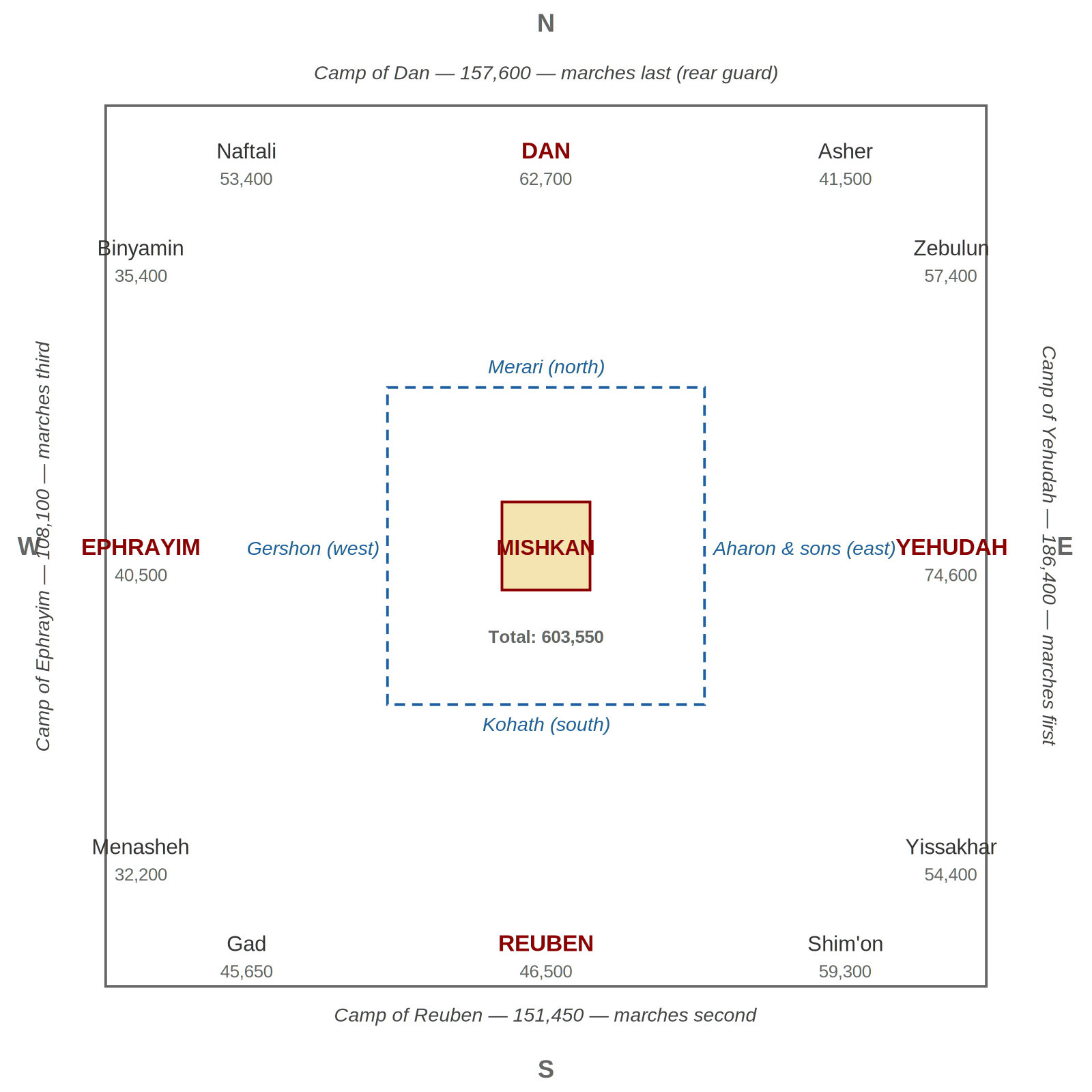
Discussion
1. The Camp as Ordered Cosmos — The Four Living Creatures With Joined Wings
The camp of Yisra'al is arranged on four sides around the mishkan, with three tribes per side, forming a closed perimeter. The Bible's throne-room visions describe an analogous formation of four living creatures (cherubim) whose wings are joined one to another, surrounding the throne of Yahuah. The wilderness camp is the earthly counterpart of the heavenly throne-arrangement. When Yisra'al camps in this closed square perimeter, they replicate on the earth the pattern that stands eternally around the throne. The tribes traditionally associated with the four cherub-faces (Yehudah/lion, Ephrayim/ox, Reuben/man, Dan/eagle or serpent) mark the four cardinal edges of the camp where the four faces of the throne-bearers face out.
1.1 — Ezekiel 1:5–12 — Four Creatures With Joined Wings
5 Also from within it came the likeness of four h702 living creatures h2416. And this was their appearance: they had the likeness of a man.
6 Each one had four faces h6440, and each one had four wings.
9 Their wings were joined one to another (חברת אשה אל־אחותה); they did not turn as they went, but each one went straight forward.
10 As for the likeness of their faces, each had the face of a man; each of the four had the face of a lion on the right side, each of the four had the face of an ox on the left side; each of the four also had the face of an eagle.
12 Each one went straight forward; they went wherever the spirit wanted to go, and they did not turn when they went.
📖 The critical phrase is v.9. חברת אשה אל־אחותה כנפיהם — “their wings were joined, a woman to her sister” — the Hebrew idiom for continuous seamless connection. The SAME idiom appears in Exod 26:3 for the tabernacle's ten curtains: חברת אשה אל־אחתה, “joined one to another,” forming one continuous covering with no gaps. The four cherubim of Ezek 1 form a closed perimeter around the throne, wings touching wings on every side. Not four discrete positions with empty space between them — a continuous surround.
📖 The parallel to Num 2 is direct. The wilderness camp is arrayed סביב (around) the mishkan — a closed perimeter of tribes touching at the corners. The heavenly throne is surrounded by cherubim with wings touching wings. Both are closed surrounds; both use continuity-language. The earthly camp mirrors the heavenly throne-formation.
📖 And note v.10: each individual creature has all four faces (man front, lion right, ox left, eagle back). Ezekiel's vision distributes the four emblems within each cherub, not one emblem per cherub. The wilderness camp, by contrast, has one lead-tribe emblem per side. Different structures, same principle: the four cardinal faces expressed in a closed formation.
1.2 — Ezekiel 10:14 — The Cherubim Reidentified
14 Each one had four faces: the first face was the face of a cherub, the second face the face of a man, the third face the face of a lion, and the fourth the face of an eagle.
📖 Ezek 10 confirms the vision of Ch 1 — these are cherubim, the throne-bearers (Ps 80:1, “you who dwell between the cherubim”; Ps 99:1, same). The tribes arrayed in the four-faced formation around the mishkan are thus arrayed in the pattern of the throne-bearers.
📖 The mishkan itself has cherubim woven into its inner veil (Exod 26:31) and cherubim of hammered gold on the kapporet (Exod 25:18–20). The camp on the outside repeats what the mishkan holds on the inside. Inner cherubim on the ark; outer “cherubim” (the twelve tribes as throne-bearing formation) around the ark. The whole camp is a cherub-structure with the ark at its center.
1.3 — Revelation 4:6–8 — The Four Living Creatures Around the Throne
6 Before the throne there was a sea of glass, like crystal. And in the midst of the throne, and around (κύκλῳ) the throne, were four living creatures full of eyes in front and in back.
7 The first living creature was like a lion, the second living creature like a calf, the third living creature had a face like a man, and the fourth living creature was like a flying eagle.
8 The four living creatures, each having six wings, were full of eyes around and within. And they do not rest day or night, saying: “Holy, holy, holy, Master Alahym Almighty, who was and is and is to come!”
📖 The same four emblems reappear at the throne in Rev 4: lion, calf/ox, man, eagle. And the Greek word for the arrangement is κύκλῳ (kuklo, “in a circle / around”) — the four creatures are around the throne in a continuous surround, not four discrete positions with gaps. Same closed-perimeter pattern as the wilderness camp and as the joined-wings cherubim of Ezek 1.
📖 And “in the midst of the throne” (v.6): the throne has an inner midst. The Lamb who is slain (Rev 5:6) stands in the midst of the throne, in the midst of the four living creatures, in the midst of the twenty-four elders. Concentric perimeters of holiness around a slain-standing Lamb. The mishkan structure prefigured this: outer camp perimeter around inner Levite perimeter around innermost holy of holies. The camp is a concentric holiness-formation — and the innermost point is the mercy seat, which prefigures the slain-standing Lamb.
📖 The four traditional tribal emblems (lion for Yehudah from Gen 49:9, ox for Ephrayim through Yoseph from Deut 33:17, man for Reuben, eagle for Dan) match the four faces of the living creatures. When the wilderness camp is arrayed around the mishkan, the tribal standards on the four sides mirror the four faces of the throne-bearers around the throne. Whatever the specifics of tribal-face assignment, the pattern is preserved: four cardinal faces, closed continuous surround, presence at the center.
1.4 — Numbers 24:5–6 — Bil'am Sees the Camp
5 How lovely are your tents, O Ya'akob! Your dwellings, O Yisra'al!
6 Like valleys that stretch out, like gardens by the riverside, like aloes planted by Yahuah, like cedars beside the waters.
📖 When the pagan prophet Bil'am is hired to curse Yisra'al, he looks down from the mountain and sees the camp in its ordered geometry. His compelled blessing describes what he sees: not a mob but a garden. The four camps arrayed in closed perimeter around the mishkan look, from above, like a planted garden with the presence at its center. Bil'am's vision is of Eden restored — the tabernacle at the center as the tree of life, the four sides of the camp perimeter as the boundaries of the garden.
📖 Compare Ezek 47 — from the eschatological temple, water flows out in four directions to heal wherever it goes. The temple-at-center-with-four-flows-outward IS the wilderness camp's geometry made permanent. Bil'am sees it from above and cannot curse what he sees.
2. East First — The Direction of the Beginning
Yehudah leads on the east. The tabernacle's entrance faces east. Eden was planted in the east. The glory returns from the east. Every eschatological revelation in scripture has an eastern orientation — the direction of the beginning is the direction from which the end will come. Yehudah's camp is not merely first; it is the direction of the primordial and the eschatological both.
2.1 — Genesis 2:8 — The Garden Planted Eastward
8 Yahuah Alahym planted a garden [h1588] eastward [h6924] in Eden, and there he put the man whom he had formed.
📖 The word מקדם (mi-qedem) means both “in the east” and “from ancient time.” Eden is in the east AND from the beginning — the direction and the primordial-past are one Hebrew word. When Yehudah's camp faces east in Num 2:3 (“kedmah mizrachah,” the double-directional), the tribe faces the direction of Eden. Every morning as the sun rose, the eastern camp saw first light — and looked toward the ancient garden.
📖 Compare Gen 3:24 — after the expulsion, cherubim were placed “at the east of the garden of Eden” to guard the way to the tree of life. The east became the guarded direction — the way back to the primordial that was closed. When Yehudah camps east of the mishkan, and Aharon's sons with him (Num 3:38, priests on the east), they camp at the direction of the ancient garden as a new set of “cherubim” — but this time not barring entry, but pointing toward the presence that has returned to dwell.
2.2 — Ezekiel 43:1–5 — The Glory Returns From the East
1 Afterward he brought me to the gate, the gate that faces toward the east.
2 And behold, the glory of the Alahym of Yisra'al came from the way of the east. His voice was like the sound of many waters; and the earth shone with his glory.
4 And the glory of Yahuah came into the temple by way of the gate which faces toward the east.
5 The Spirit lifted me up and brought me into the inner court; and behold, the glory of Yahuah filled the temple.
📖 The Ezekiel-vision of the returning glory: it comes from the east. Yahuah's presence departed via the east in Ezek 11:23 (“the glory of Yahuah went up from the midst of the city and stood on the mountain, which is on the east side of the city”) and returns via the east in Ezek 43. The direction of departure is the direction of return.
📖 When Yehudah's camp faces east in the wilderness, they face the direction from which glory departs and to which glory returns. Every morning the eastern camp watches the horizon. The messianic tribe stands as the sunrise-facing sentinel of the whole covenant people.
2.3 — Matthew 2:1–2 — The Magi From the East
1 Now after Yahusha was born in Beit-Lechem of Yehudah in the days of Herod the king, behold, magi from the east came to Yerushalayim,
2 saying: “Where is he who has been born King of the Yehudim (Jews)? For we have seen his star in the east and have come to worship him.”
📖 The magi come from the east and follow a star from the east. The King of the Yehudim (of Yehudah, the eastern tribe) is heralded by an eastern sign witnessed by eastern seekers. The east-orientation of Yehudah's camp finds its fulfillment when the King of Yehudah's tribe is announced by an eastern star. The camp's eastward face has been a nation-long anticipation of that announcement.
📖 And Matt 2:11: the magi bring gold, frankincense, and myrrh. Frankincense was ABSENT from the sotah offering (Num 5) — the offering under judgment lacks the pleasing aroma. But the magi bring frankincense to the infant Yahusha. The Bridegroom is worshipped with the aroma the covenant-bride's offerings had been unable to bear. What was withheld from the ordeal-offering is presented at the incarnation. The east-facing tribe of Yehudah receives at the coming of its King the aromatic sign of a favored, unshadowed offering.
2.4 — Matthew 24:27 — As the Lightning Comes From the East
27 For as the lightning comes from the east and flashes to the west, so also will the coming of the Son of Man be.
📖 The eschatological coming is described as an east-to-west movement. The Bridegroom returns from the direction the eastern camp faced all along. The four camps arranged east/south/west/north are, in the Yahusha's statement, positioned to receive a coming that begins east and flashes west. Yehudah's camp faces the direction of the return; Ephrayim's camp (west) faces the direction the flash goes toward.
📖 And note: the Mount of Olives, from which Yahusha ascended (Acts 1:9–12) and to which he will return (Zech 14:4), lies EAST of Yerushalayim. The ascent was eastward; the return will be eastward. The whole trajectory of the Bridegroom's movements is bracketed by east. Yehudah's wilderness position is a permanent covenantal sentinel-post for the direction of the King's return.
3. The Lion of Yehudah Leads — The Messianic Vanguard
Yehudah camps east, leads the largest camp (186,400), marches first, and stands under a tribal banner traditionally associated with the lion. Every element points forward to the King who will rise from this tribe. When the covenant nation moves through the wilderness, the lion-tribe is at the head. When the eschatological Lamb opens the scroll, he is announced as the Lion of Yehudah. The wilderness geometry places the messianic tribe at the leading edge of the covenant advance.
3.1 — Genesis 49:8–10 — Ya'akob's Blessing on Yehudah
8 Yehudah, you are he whom your brothers shall praise; your hand shall be on the neck of your enemies; your father's children shall bow down before you.
9 Yehudah is a lion's whelp; from the prey, my son, you have gone up. He crouches down, he lies down as a lion; and as a lion, who shall rouse him?
10 The scepter shall not depart from Yehudah, nor a lawgiver from between his feet, until Shiloh comes; and to him shall be the obedience of the peoples.
📖 The lion-imagery on the deathbed of the patriarch. Yehudah is a lion's whelp, a crouching lion, a lion no one rouses. Ancient Jewish tradition assigns the lion emblem to Yehudah's tribal banner on the basis of this blessing. When the eastern camp's standard flies in Num 2:3, the lion of Ya'akob's blessing is visible over the leading camp.
📖 “The scepter shall not depart from Yehudah… until Shiloh comes.” The scepter-promise is anchored in Yehudah. When the tribe leads the wilderness march, they carry the scepter-promise at the head of the procession. Every step the leading camp takes is a step of the tribe destined to carry the scepter until the coming of Shiloh (a messianic title, from a root meaning “the one to whom it belongs” or “peace-bringer”).
3.2 — Revelation 5:5 — The Lion of the Tribe of Yehudah
5 But one of the elders said to me: “Do not weep. Behold, the Lion of the tribe of Yehudah [G2455], the Root of David, has prevailed to open the scroll and to loose its seven seals.”
📖 The eschatological completion of the lion-of-Yehudah promise. The one who opens the scroll of history is the Lion of Yehudah. And v.6 immediately reveals: “behold, in the midst of the throne and of the four living creatures, and in the midst of the elders, stood a Lamb as though it had been slain.” The Lion is a Lamb. The prophesied lion of the tribe of Yehudah is revealed as the slain Lamb standing in the midst of the throne.
📖 The wilderness camp arranged Yehudah at the east, first in the marching order, under the lion-banner. Every generation of Yisra'al from Sinai to Rev 5 has camped in a formation that awaited the Lion. Rev 5 announces: he has come. And the Lion turns out to be the Lamb slain from before the foundation of the world. The eastern camp's lion-standard finds its meaning in a slain-standing Lamb.
3.3 — Matthew 1:2–4 — Nachshon in the Genealogy
2 Abraham begot Yitschak, Yitschak begot Ya'akob, and Ya'akob begot Yehudah and his brothers.
3 Yehudah begot Perets and Zerach by Tamar, Perets begot Chetsron, and Chetsron begot Ram.
4 Ram begot Amminadab, Amminadab begot Nachshon, and Nachshon begot Salmon.
📖 Matthew names Nachshon in the direct genealogy of Yahusha. The very prince who marches at the head of Yehudah's camp in Num 2:3 is a direct ancestor of the Mashiach. The eastern camp is led not just by the messianic tribe but by a man in the messianic bloodline. Every step Nachshon took at the front of the wilderness column was a step of a man carrying the seed that would produce the King.
📖 And note Nachshon's family. Ancient Jewish tradition (Sotah 37a) preserves a legend that Nachshon was the first to step into the sea at the crossing of the Red Sea — before the waters had parted, in an act of faith, he waded in up to his neck, and only then did the waters part. Whether or not the legend is historical, its instinct is right: the leader of Yehudah's tribe steps first into the impossible. The messianic-line prince at the head of the wilderness column is the archetype of leading faith.
3.4 — Hebrews 7:14 — Our Master Arose From Yehudah
14 For it is evident that our Master arose from Yehudah, of which tribe Moshe spoke nothing concerning priesthood.
📖 The writer of Hebrews notes the paradox: Yahusha is priest, but he came from Yehudah, not Levi. The tribe that led the war-camp becomes the tribe from which the true High Priest arises. The priesthood is transferred from Levi (Num 3, the tabernacle's inner ring) to Yehudah (Num 2, the leading war-camp). The King-Priest emerges from the tribe of the scepter, not the tribe of the incense. This transfer of priestly office is the New Covenant's deepest ordering-change: the priesthood is joined to the kingship in one person, and both descend from Yehudah.
📖 The wilderness camp had Levi on the inside (priestly service) and Yehudah on the east (war-leadership). In the Bridegroom, the two functions unite. He is priest AND king, Levite-service AND Yehudah-scepter, incense AND lion. The two circles of holiness (inner Levite, outer Yehudah) collapse into one person — the King who is also the Priest.
4. The Tabernacle at the Center — The Presence in the Midst
The mishkan is not at the head of the camp or at the head of the marching column; it is at the CENTER, always in the midst. This is a specifically covenantal geometry — ancient Near Eastern kings led their armies with their tents at the head. Yahuah puts himself in the middle, surrounded on four sides by his people. The presence-in-the-midst is the defining shape of covenant existence, and the pattern extends from the wilderness mishkan through the incarnation to the eschatological city.
4.1 — Exodus 25:8 — Let Them Make Me a Sanctuary
8 “And let them make me a sanctuary [h4720], that I may dwell [h7931] among them [h8432].”
📖 The Torah's foundational statement of the mishkan's purpose. The verb שכן (shakhan, to dwell) is the root of משכן (mishkan) itself. Yahuah does not command a temple to be built; he commands a dwelling — a place where he will pitch his tent among the tents of his people. The mishkan is fundamentally a tent among tents. Yisra'al lives in tents; Yahuah pitches his tent with them.
📖 בתוכם (b'tokham) — “in their midst.” The same word that appears in Num 2:17 (“in the midst of the camps”). The midst is the ordained location for the presence. Not far above, not at the head, not at the rear — in the midst. Compare Lev 26:12 (“I will walk among you and be your Alahym”) and Isa 12:6 (“great is the Holy One of Yisra'al in your midst”).
4.2 — John 1:14 — The Word Tabernacled Among Us
14 And the Word became flesh and dwelt [G4637] among us, and we beheld his glory, the glory as of the only-begotten of the Father, full of grace and truth.
📖 The Greek word ἐσκήνωσεν (eskenosen) is from σκηνή (skene, tent/tabernacle) — the LXX word for the mishkan. Yochanan writes: “the Word became flesh and tabernacled among us.” The wilderness mishkan is fulfilled in the incarnation: the same divine dwelling that pitched its tent in the midst of the camp now pitches its tent in a human body. Yahusha IS the mishkan in flesh.
📖 And “we beheld his glory” — the same glory (כבוד יהוה, kavod Yahuah) that filled the mishkan when it was consecrated (Exod 40:34–35). What filled the tabernacle at Sinai became visible in the person of Yahusha in Yerushalayim. The wilderness pattern extends: the presence in the midst of the camp becomes the presence in the midst of humanity.
📖 And note the location of Yahusha's ministry: he moves throughout Yisra'al, not fixed at a temple. Compare Matt 18:20 — “where two or three are gathered together in my name, I am there in the midst of them.” The mishkan-in-the-midst pattern is now portable: wherever the covenant people gather, the Presence is in the midst. The wilderness structure has become the assembly-life structure.
4.3 — Revelation 21:3 — The Tabernacle of Alahym Is With Men
3 And I heard a loud voice from heaven saying: “Behold, the tabernacle [G4633] of Alahym is with men, and he will dwell [G4637] with them, and they shall be his people. Alahym himself will be with them and be their Alahym.”
📖 The eschatological consummation. The Greek is precise: σκηνή (skene, tabernacle) and σκηνόω (skenoo, to tabernacle) — the same words as John 1:14 and the LXX for the wilderness mishkan. The wilderness camp's central feature — the tabernacle in the midst — is what Yochanan sees at the end: the tabernacle of Alahym is with men, and he will tabernacle with them. The wilderness geometry is the eschatological reality.
📖 And Rev 21:22: “I saw no temple in it, for the Master Alahym Almighty and the Lamb are its temple.” The final city has no separate temple building because the presence itself, in the person of the Lamb, IS the temple. The camp-mishkan-with-tribes-around pattern completes in a city where the presence needs no mediating structure. The whole city is the holy of holies.
📖 But the four-camps pattern persists: Rev 21:12–13 — twelve gates, three on each of the four sides, each bearing the name of a tribe of Yisra'al. The Num 2 geometry is preserved. The city has four walls with three tribal gates each, exactly as the wilderness camp had four sides with three tribes each. The eternal city IS the ordered wilderness camp made permanent. The four-camps geometry is not shadow that passes when substance arrives — it is the substance itself, revealed as the shape of the final city.
4.4 — 1 Corinthians 3:16–17 — You Are the Temple
16 Do you not know that you are the temple [G3485] of Alahym and that the Spirit of Alahym dwells [G3611] in you?
17 If anyone defiles the temple of Alahym, Alahym will destroy him. For the temple of Alahym is holy, which temple you are.
📖 Sha'ul extends the mishkan-pattern to the assembly. The Corinthian assembly is the temple; the Spirit dwells in them corporately. The wilderness camp had the mishkan in the midst; the assembly IS the mishkan in the world. This is why interpersonal sin within the assembly is treated with such gravity in 1 Cor 5 (put out the wicked one) and 1 Cor 11 (the ordeal at the Table) — the assembly's holiness is the presence's dwelling place. The Num 5 principle (defilement expelled because Yahuah dwells in the midst) applies to the New Covenant assembly.
📖 And 1 Cor 6:19 — “your body is the temple of the Ruach ha-Qodesh (Holy Spirit) who is in you.” The mishkan pattern extends to the individual believer. Each body a temple, each assembly a mishkan, each gathering a wilderness camp with the presence in the midst. The Num 2 geometry replicates from cosmos to nation to assembly to person.
5. The Ordered Procession — Camp and Marching Order Prefigure the Eschaton
Numbers 2 gives both the resting camp arrangement AND the marching order — and v.17 explicitly says they are one: “as they encamp, so shall they journey.” The static geometry and the dynamic order match. Yehudah first, Reuben second, the mishkan in the middle, Ephrayim third, Dan last. This is not just wilderness logistics — it is the shape of the eschatological procession. Revelation preserves the twelve-tribe geometry through history to the final city. The four camps and their marching order are the pattern of the whole covenant people moving through history toward the promised land.
5.1 — Numbers 10:33–36 — The Ark Sets Out
33 So they departed from the mountain of Yahuah on a journey of three days, and the ark of the covenant of Yahuah went before them for the three days' journey, to search out a resting place for them.
35 So it was, whenever the ark set out, that Moshe said: “Rise up, O Yahuah! Let your enemies be scattered, and let those who hate you flee before you.”
36 And when it rested, he said: “Return, O Yahuah, to the many thousands of Yisra'al.”
📖 The ark leads the whole march. Even though the camp arrangement places the mishkan in the middle (Num 2:17), the ARK specifically goes before the people for the three days' journey. This is because the ark is the war-standard of the King. Compare Josh 3–6 (the ark crossing the Yarden before the people; the ark circling Yericho seven days). The mishkan is stationary-central; the ark is dynamic-leading. The presence has both aspects: enthroned in the midst when they camp, marching at the head when they advance to conquer.
📖 Moshe's prayer “Rise up, O Yahuah!” is a war-cry. When the ark rises, the King rises to battle. When the ark rests, the King returns to his throne in the midst of his people. The two-phase movement of the ark corresponds to two aspects of the King's work: aggressive (going before to scatter enemies) and immanent (dwelling in the midst).
5.2 — Revelation 7:4–8 — The Sealed 144,000 by Tribe
4 And I heard the number of those who were sealed: 144,000 of all the tribes of the children of Yisra'al were sealed.
5 Of the tribe of Yehudah 12,000 were sealed; of the tribe of Reuben 12,000 were sealed; of the tribe of Gad 12,000 were sealed;
📖 The eschatological census preserves the twelve-tribe structure of the wilderness camp. And note the order in Rev 7:5–8: Yehudah is listed FIRST, even though he was Ya'akob's fourth son by Leah. The messianic tribe leads the eschatological seal-list the same way it led the wilderness marching order. The Num 2 leading position is preserved at Rev 7.
📖 And Dan is omitted from Rev 7's seal-list — the tribe that led the wilderness rear-guard is the tribe that fails to make the eschatological seal. Yoseph appears in Rev 7 (not Ephrayim) — probably a recognition that the tribe of Dan's idolatry (Judg 18, 1 Kings 12) forfeited the tribe's eschatological standing, with Yoseph or Menasheh taking the place. The twelve-tribe structure survives the whole biblical arc, but the specific tribe-composition adjusts based on covenant fidelity.
5.3 — Revelation 21:12–14 — The Twelve Gates in Four Directions
12 Also she had a great and high wall with twelve gates, and twelve angels at the gates, and names written on them, which are the names of the twelve tribes of the children of Yisra'al.
13 Three gates on the east, three gates on the north, three gates on the south, and three gates on the west.
14 Now the wall of the city had twelve foundations, and on them were the names of the twelve apostles of the Lamb.
📖 The Num 2 geometry made permanent. Rev 21:13 gives exactly the Numbers 2 pattern: three gates on each of the four cardinal directions. The wilderness camp's four sides of three tribes each become the eternal city's four walls of three gates each. The formation Yisra'al held for the forty years of the wilderness is the formation of the final city.
📖 And the tribal names are ON the gates. Every entrance to the New Yerushalayim bears a tribal name. To enter, one passes through a gate bearing the name of one of the twelve tribes of the wilderness camp. The wilderness geometry is not shadow superseded by a new pattern; it is the pattern itself, preserved eternally.
📖 And the foundations bear the names of the twelve apostles. Two structures meet in the city's architecture: the twelve tribes of Yisra'al (the wilderness camp) and the twelve apostles of the Lamb (the New Covenant governance). The final city is built on both. Yisra'al's wilderness formation and the apostolic-messianic assembly are married in the architecture of the eternal city. Compare Eph 2:20 (“built on the foundation of the apostles and prophets, Yahusha Mashiach himself being the chief cornerstone”).
5.4 — Hebrews 12:22–24 — You Have Come to Mount Tsiyon
22 But you have come to Mount Tsiyon and to the city of the living Alahym, the heavenly Yerushalayim, to an innumerable company of angels,
23 to the general assembly and assembly of the firstborn who are registered in heaven, to Alahym the Judge of all, to the spirits of just men made perfect,
24 to Yahusha the Mediator of the new covenant, and to the blood of sprinkling that speaks better things than that of Hebel (Abel).
📖 The writer of Hebrews describes the destination of the covenant people in language that fuses wilderness and eschaton. “You have come to… the heavenly Yerushalayim… to the general assembly.” The Greek word πανηγύρις (paneguris, “general assembly”) is used for a great festal gathering. The wilderness camp arrayed around the mishkan is a paneguris in seed form; the heavenly Yerushalayim is the paneguris in fullness.
📖 And “the assembly of the firstborn who are registered in heaven” — the census language of Num 1–2 applied to the eschatological assembly. Every believer is a name in a wilderness-census-style register kept in heaven. The Num 2 formation is the deep pattern of the heavenly city's inhabitants: named, counted, arranged, marching under the Bridegroom's banner toward the promised city they have already begun to enter.
📖 The camp of Num 2 is not a curiosity of ancient logistics. It is the pattern of the covenant assembly's existence in every age. To be a covenant person is to be part of the ordered geometry around the presence. The tribes at the four sides, the Levites at the inner ring, the mishkan at the center, the King in the midst — this is the shape of the assembly's life until the final gate opens and the wilderness march arrives at the city that was its destination from the beginning.
6. The Fourfold Twelvefold Pattern — Camp, Cherubim, City, and Breastplate
The wilderness camp's formation is not a one-off arrangement. The Torah and the prophets repeatedly deploy the same pattern: four cardinal directions, twelve elements distributed across them (three per direction), a bounded center holding the presence of Yahuah. The pattern appears in four distinct scriptural structures: the wilderness camp (Num 2), the throne-formation of the four living creatures (Ezek 1, 10; Rev 4), the eschatological city (Ezek 48; Rev 21), and the high priest's breastplate (Exod 28, 39). Each of these carries twelve elements in a fourfold cardinal arrangement. The four structures speak to each other across the canon — they are all instances of one deep pattern of covenant order, presented at different scales (cosmic, national, ecclesial, priestly) and at different moments in the story (wilderness, exile-vision, incarnation, eschaton). The camp is the pattern lived; the throne is the pattern eternal; the city is the pattern completed; the breastplate is the pattern carried on the priest's heart.
6.1 — Ezekiel 48:30–35 — Twelve Gates in Four Directions
30 These are the exits of the city on the north side, four thousand five hundred cubits by measure.
31 The gates of the city shall be according to the names of the tribes of Yisra'al: three gates northward — the gate of Reuben one, the gate of Yehudah one, the gate of Levi one.
32 On the east side, four thousand five hundred cubits, three gates: the gate of Yoseph one, the gate of Binyamin one, the gate of Dan one.
33 On the south side, four thousand five hundred cubits by measure, three gates: the gate of Shim'on one, the gate of Yissakhar one, the gate of Zebulun one.
34 On the west side, four thousand five hundred cubits, with their three gates: the gate of Gad one, the gate of Asher one, the gate of Naftali one.
35 All the way around (סביב) shall be eighteen thousand cubits; and the name of the city from that day shall be: YAHUAH IS THERE.
📖 The definitive fourfold-twelvefold text. Ezekiel's eschatological city has 4,500 cubits per side (perfect square) with three tribal gates on each of the four sides. Twelve tribes distributed around a square perimeter, three per direction. And v.35 explicitly seals it with the closing word סביב (saviv, “around”) giving the total perimeter length: 18,000 cubits (4 × 4,500).
📖 The name of the city is יהוה שמה (Yahuah shammah), “Yahuah is there.” The presence-at-the-center that defined the wilderness camp is now the city's NAME. The whole city is named for the fact that Yahuah dwells inside it. The wilderness pattern (mishkan at center of closed perimeter) becomes the eschatological city's permanent identity.
📖 And note the tribal redistribution. In Num 2 the four sides had: East Yehudah, South Reuben, West Ephrayim, North Dan. In Ezek 48 they are: North Reuben/Yehudah/Levi, East Yoseph/Binyamin/Dan, South Shim'on/Yissakhar/Zebulun, West Gad/Asher/Naftali. The tribes are redistributed but the geometric pattern is preserved. Levi is included (in Num 2 Levi was set apart from the twelve war-camps); Yoseph appears as one tribe (not split into Ephrayim/Menasheh). The completion adjusts the composition without disturbing the geometry. Fourfold-twelvefold-closed-perimeter is stable.
6.2 — Revelation 21:12–16 — The New Yerushalayim Square Perimeter
12 Also she had a great and high wall with twelve gates, and twelve angels at the gates, and names written on them, which are the names of the twelve tribes of the children of Yisra'al.
13 Three gates on the east, three gates on the north, three gates on the south, and three gates on the west.
14 Now the wall of the city had twelve foundations, and on them were the names of the twelve apostles of the Lamb.
16 The city is laid out as a square (τετράγωνος); its length is as great as its breadth.
📖 Yochanan's eschatological city is laid out as a square (κεῖται τετράγωνος, keitai tetragonos — literally “lies four-sided/square”), with three gates on each of four sides. Same geometry as Ezek 48. Same geometry as Num 2. Same pattern of twelve tribes distributed around a closed square perimeter with the presence at the center.
📖 And the twelve foundations bear the names of the twelve apostles of the Lamb (v.14). Two structures meet in the city's architecture: the twelve tribes of Yisra'al (the wilderness camp geometry) and the twelve apostles of the Lamb (the New Covenant governance). The final city is built on both. Yisra'al's wilderness formation and the apostolic-messianic assembly are married in the architecture of the eternal city (Eph 2:20, “built on the foundation of the apostles and prophets, Yahusha Mashiach himself being the chief cornerstone”).
📖 And v.22: “I saw no temple in it, for the Master Alahym Almighty and the Lamb are its temple.” The mishkan-at-center pattern completes: the presence no longer requires a mediating tent because the presence IS the temple. The vertical axis (mishkan → temple → stauros) becomes the city itself.
6.3 — Exodus 28:15–21 — The Twelve Stones of the Breastplate
17 “And you shall put settings of stones in it, four rows (ארבעה טורים) of stones: the first row shall be a sardius, a topaz, and an emerald; this shall be the first row.
18 “The second row shall be a turquoise, a sapphire, and a diamond.
19 “The third row, a jacinth, an agate, and an amethyst.
20 “And the fourth row, a beryl, an onyx, and a jasper. They shall be set in gold settings.
21 “And the stones shall have the names of the sons of Yisra'al, twelve according to their names, like the engravings of a signet, each one with its own name; they shall be according to the twelve tribes.”
📖 Twelve stones in a fourfold arrangement. The Hebrew is ארבעה טורים אבן — “four rows/lines of stones,” three per row/line, twelve total. The breastplate is a square pouch (Exod 28:16, “a span its length and a span its breadth, being doubled”) carried on the high priest's heart.
📖 The function is critical: Exod 28:29 — “Aharon shall bear the names of the sons of Yisra'al in the breastplate of judgment upon his heart when he goes into the holy place, for a memorial before Yahuah continually.” The priest carries the twelve tribes into the presence. The breastplate is a portable, wearable version of the camp: twelve tribes in fourfold arrangement, worn on the heart of the mediator, brought into the presence at every priestly approach.
📖 The high priest wearing the breastplate IS the pattern-in-miniature. As the wilderness camp is arrayed around the mishkan on the ground, the high priest carries the twelve tribes into the mishkan on his chest. What the camp does spatially, the priest does personally. And when Yahusha stands as the true high priest in the heavenly holy of holies (Heb 9:11–12), he carries all who belong to him into the presence — the ultimate fulfillment of the priest-bearing-the-tribes pattern.
6.4 — The Unified Pattern — Four Structures, One Geometry
Structure | Fourfold Element | Twelvefold Element | Center
|
Wilderness camp (Num 2) | Four camps at cardinal directions | Twelve tribes, three per camp | Mishkan (vertical axis) |
Living creatures (Ezek 1, Rev 4) | Four cherubim with wings joined | (Four faces × three “living” aspects) | Throne (with slain-standing Lamb) |
Eschatological city (Ezek 48, Rev 21) | Four square sides | Twelve tribal gates, three per side | Alahym-and-Lamb as temple |
High priest's breastplate (Exod 28) | Four rows of stones | Twelve engraved names, three per row | The priest's heart (before Yahuah) |
📖 The four structures are not four different patterns; they are one pattern at four scales.
— The wilderness camp is the pattern at national scale — a whole nation arranged around the presence.
— The living creatures are the pattern at cosmic scale — the throne of Yahuah surrounded by his throne-bearers in the heavenly court.
— The eschatological city is the pattern at eschatological scale — the completed and eternal covenant community arrayed around the presence-that-IS-the-temple.
— The breastplate is the pattern at priestly scale — the mediator carrying the twelve tribes on his heart into the presence.
📖 The pattern says: the covenant people are ordered as twelve around a center-presence, in four cardinal-facing directions, forming a closed formation with the presence in the middle. When Yahusha comes as the true high priest (Heb 7–9), when he tabernacles among us (John 1:14), when he becomes the vertical axis at Golgotha (the stauros standing upright on the hill), when he returns to reign from the throne surrounded by the four living creatures (Rev 4–5), and when the New Yerushalayim descends as the eternal fulfillment (Rev 21) — every one of these is a moment where the fourfold-twelvefold-closed-perimeter pattern is enacted. Numbers 2 is the pattern given its earliest large-scale expression on earth. Every subsequent structure carries the same geometry forward.
📖 And note the CENTER in each case: the mishkan (with the ark and mercy seat inside), the throne (with the Lamb in the midst), the temple-that-IS-the-Master (Rev 21:22), the priest's heart (bearing the tribes). Every center is a place where the presence meets the mediated approach. The vertical axis at the center is where heaven and earth meet. The wilderness camp's central mishkan is the earliest lived version of this cosmic meeting-point. Every believer's heart, in New Covenant fulfillment, is the innermost version — a small mishkan (1 Cor 6:19) with the presence dwelling within.
📖 The camp of Num 2 is not a curiosity of ancient logistics. It is the deep geometric grammar of scripture — the shape covenant life takes at every scale, in every age, from wilderness to eternal city.